Types of Container Handling Forklifts and Reach Stackers
In modern container logistics and terminal operations, container handling forklifts and reach stackers are the most versatile and cost-effective cargo handling equipment. Container handling vehicles are categorized into multiple specialized configurations, primarily divided into laden container reach stackers and empty container handlers.
Laden Container Handlers vs. Empty Container Handlers
During standard supply chain cycles, after import container devanning or stripping, empty containers have vastly lower tare weights than fully laden containers. To optimize capital investment and fuel efficiency, the port industry utilizes dedicated empty container handlers alongside heavy-duty laden reach stackers, as highlighted in the comparison below:
| Container Type | Average Tare Weight (Empty) | Average Gross Weight (Laden) |
| 20-Foot Container | 2.3 tonnes | Up to 30.5 tonnes |
| 40-Foot Container | 3.7 tonnes | Up to 30.5 tonnes |
| 45-Foot Container | 4.7 tonnes | Up to 33.0 tonnes |
Within the empty container handling segment, machines are further divided into two primary structural types: telescopic boom reach stackers and vertical mast empty container handlers.
Classification by Power Source: Diesel vs. Electric & Hybrid
Modern container handling fleets are powered by two main propulsion systems: conventional diesel engines and electric/hybrid drivetrains. Depending on commercial strategies, sustainability mandates, and local environmental regulations, terminal operators select appropriate fleet configurations based on specific operational trade-offs:
Diesel-Powered Container Handlers
Diesel-powered equipment offers lower upfront acquisition costs, mature supply chains for spare parts, ubiquitous technical maintenance services, and crucially, 24/7 continuous duty capability with rapid refueling.
The primary drawback of diesel machinery lies in higher long-term fuel consumption, exhaust emissions, and higher routine oil and filter maintenance expenses.
Electric and Hybrid Reach Stackers
Driven by global port decarbonization trends and ESG mandates, electrification of port handling equipment is accelerating rapidly.
Port equipment specialists recognize that container handlers are ideal candidates for electrification. Heavy container handling prioritizes low-end torque and immediate power delivery over top travel speed—areas where electric drivetrains drastically outperform internal combustion engines.
Furthermore, electric reach stackers convert the inherent weight of heavy industrial battery packs into effective counterweights, turning a design challenge into a stability advantage that provides sustained operating energy for multi-hour shifts.
Similarly, hybrid reach stackers combine smaller, fuel-efficient diesel generator sets with battery packs and regenerative braking systems, maximizing fuel savings while eliminating extensive charging downtime.
With cutting-edge battery technology, pure electric container handlers feature battery capacities ranging from 1,200 to 1,500 Ah, supporting ultra-fast charging within 3 to 4 hours to deliver 7 to 8 hours of continuous operation per charge.
While exceptionally promising from total cost of ownership (TCO) and emissions perspectives, charging infrastructure investments and charging cycle logistics remain key evaluation points for fleet operators.
Types of Empty Container Handlers
Empty container handling machinery comprises two primary designs:
- Telescopic Boom Type: Empty Reach Stacker
- Vertical Mast Type: Empty Container Handler (ECH)
Vertical Mast Empty Container Handlers
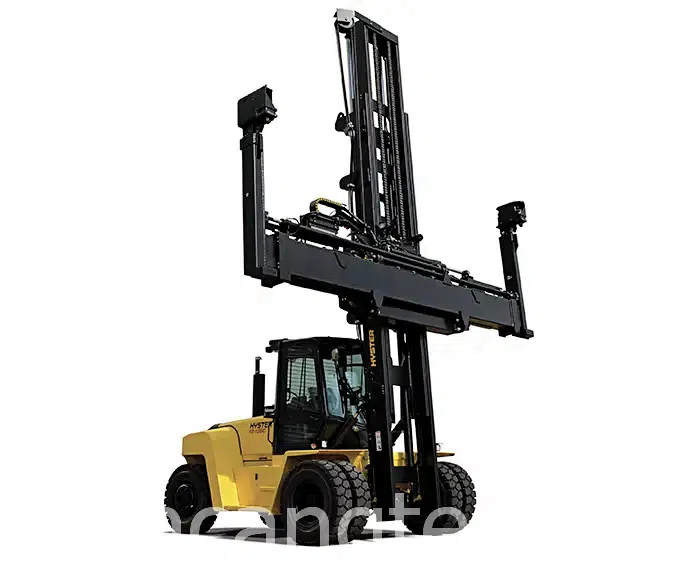
Vertical mast empty handlers utilize a rigid vertical mast mechanism similar to standard forklifts, engineered to lift empty 20ft, 40ft, and 45ft containers up to heights exceeding 20 meters (stacking 6 to 8 container tiers high).
These machines feature elevated operator cabins for optimal sightlines when positioning spreaders at maximum stacking heights. Because vertical mast handlers can only service the frontmost 1st row of container stacks, they are ideally suited for dedicated empty container yards and ICDs with dedicated block layouts.
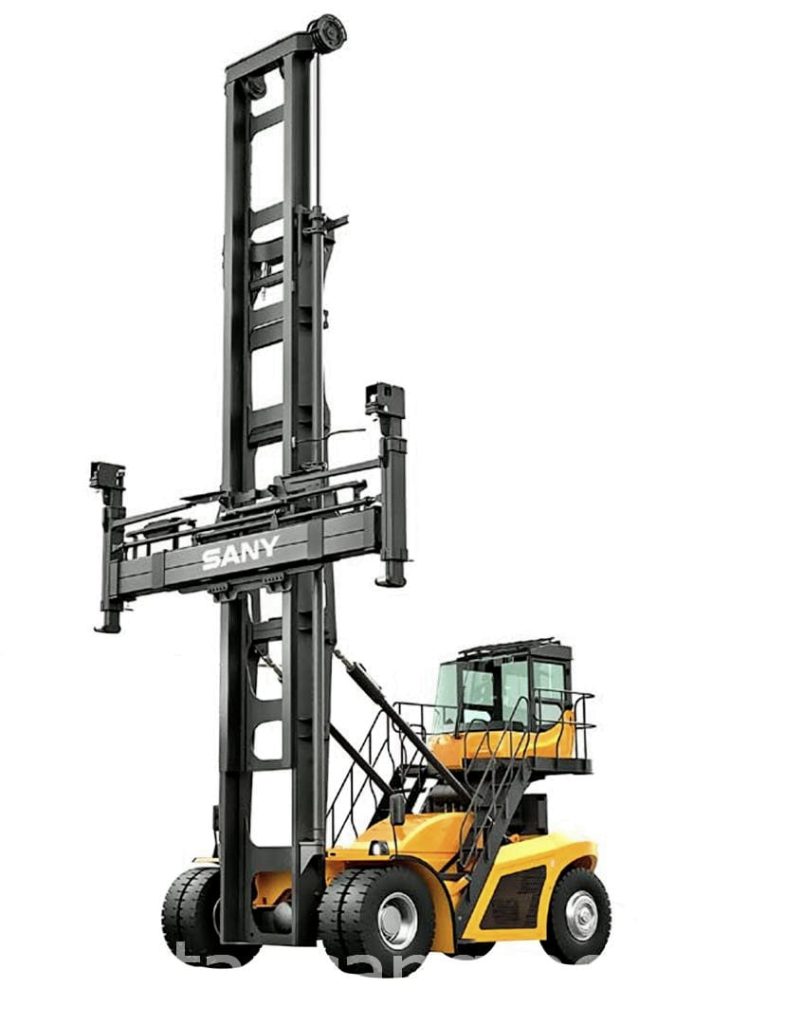
Additionally, compact empty handling conversions exist where side-spreader attachments are mounted on heavy-duty 16–22 tonne standard forklift chassis. While stacking height is limited to 2–3 tiers and visibility is reduced, equipment costs are approximately one-third lower than dedicated high-mast handlers.
Telescopic Empty Reach Stackers
Telescopic boom empty reach stackers can reach across container rows to access containers in the 2nd and 3rd stacking rows:
Lifting Capacity across 1st / 2nd / 3rd Rows: 12,000 kg | 10,000 kg | 5,000 kg
Load Center Distance across 1st / 2nd / 3rd Rows: 1,780 mm | 3,850 mm | 6,400 mm
Widely utilized in import-export yards, empty reach stackers efficiently stack 20ft to 40ft containers up to 5 to 6 tiers high with superior yard maneuvering flexibility.
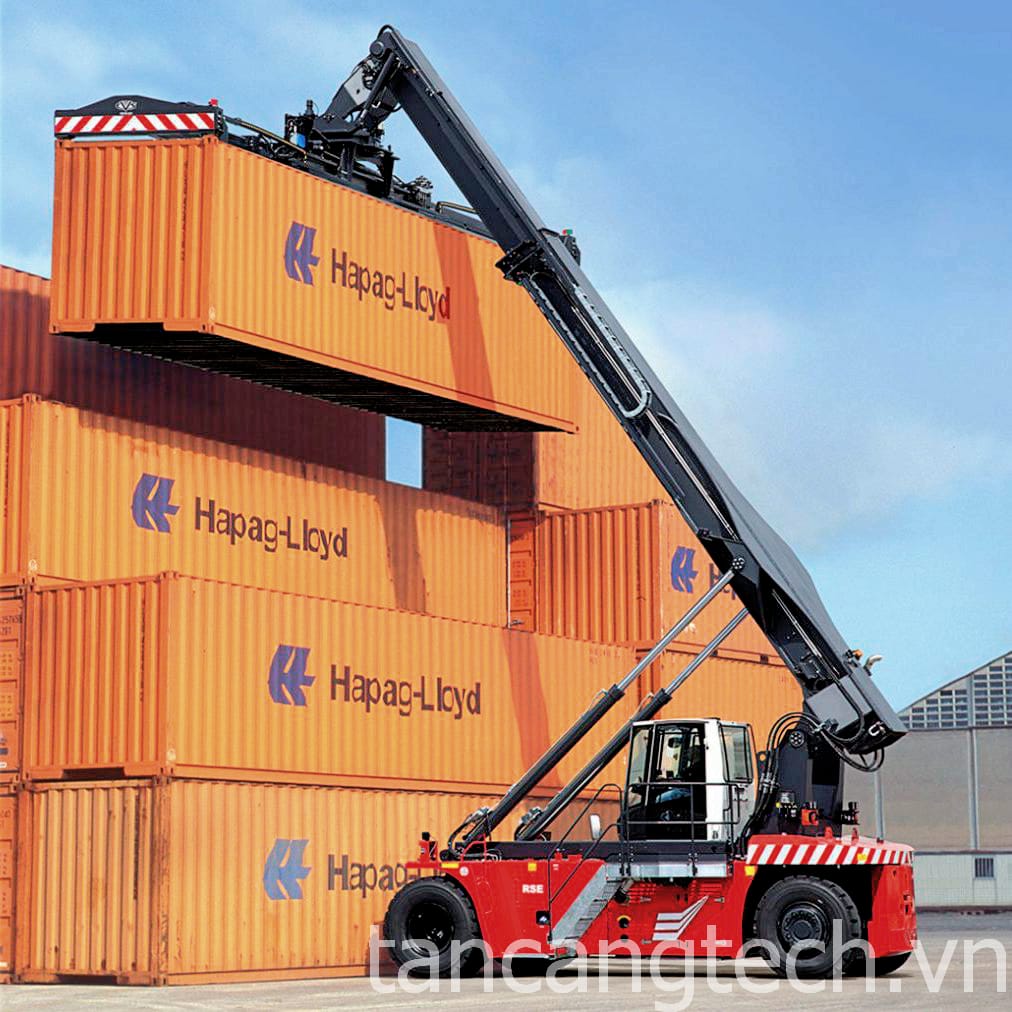
Equipped with hydraulic telescopic booms and specialized empty container spreaders, these units provide unmatched agility with lifting capacities ranging from 12 to 15 tonnes.
Laden Container Reach Stackers
Laden container reach stackers share a similar structural concept with empty reach stackers but feature heavily reinforced chassis, robust boom sections, larger hydraulic cylinders, and high-capacity hydraulic twistlock spreaders:
Lifting Capacity across 1st / 2nd / 3rd Rows: 45,000–50,000 kg | 27,000–31,000 kg | 13,000–16,000 kg
Load Center Distance across 1st / 2nd / 3rd Rows: 1,780 mm | 3,850 mm | 6,400 mm
Strategic Fleet Recommendations for Terminal Operators
Container handling equipment remains the backbone of seaports, inland depots, and logistics parks due to moderate capital requirements, high mobility, and rapid deployment. To optimize fleet performance, operators should evaluate:
-
Operational Profile: Select equipment based on container weight distribution, stacking density, and row accessibility requirements.
-
Total Cost of Ownership (TCO): Balance initial capital expenditure against fuel/energy efficiency and lifecycle maintenance costs.
-
Technical Support & Spare Parts: Partner with proven technical providers capable of rapid on-site troubleshooting and component supply.
-
Preventive Maintenance Regimes: Implement rigorous inspection schedules to prevent catastrophic component failures and maximize uptime.
For genuine spare parts, turnkey overhauls, structural inspection, and comprehensive maintenance services for container reach stackers and forklifts, contact Tan Cang Tech. We deliver premium, cost-effective engineering solutions to keep your container handling operations running at peak productivity.