In the realm of logistics and heavy industry, forklifts and mobile lifting equipment serve as the lifeblood of material handling operations. From agile industrial forklifts operating inside warehouses to heavy-duty reach stackers managing container yards, each machine performs an indispensable role.
However, when it comes to repair and maintenance, there is a common and hazardous misconception: treating all lifting equipment alike. This oversight can lead to massive cost overruns, prolonged unscheduled downtime, and severe occupational safety hazards.
This article provides a rigorous comparative analysis, explaining why maintaining and overhauling a container reach stacker is fundamentally different from servicing a conventional forklift, and why you need an experienced technical team to handle these heavy machines.

Shared Maintenance Fundamentals
Regardless of size, all forklifts and mobile lifting equipment share several fundamental maintenance principles that every technical team must master:
-
Powertrain & Engine Systems: Whether Diesel, Electric, or LPG, routine oil changes, cooling system flushes, air filter replacements, and battery servicing are mandatory preventive tasks.
-
Basic Hydraulic Maintenance: Monitoring hydraulic oil levels, filter condition, and inspecting standard hoses and hydraulic cylinders for leaks.
-
Brake & Tire Inspection: Verifying brake shoe/disc wear, testing braking responsiveness, and ensuring proper tire pressure and tread integrity.
-
General Safety Audits: Inspecting lighting systems, audible horns, mirrors, and basic safety interlocks to maintain strict roadworthiness.
While these represent essential baseline maintenance skills, stopping here when servicing a container reach stacker will inevitably result in severe technical oversights.
Core Technical Differences
The difference in servicing these two classes of machinery is comparable to the difference between changing the oil on a motorbike versus completely overhauling a heavy haulage truck engine.
1. Lifting Mechanism: Fork Tines (Forks) vs. Telescopic Boom
-
Conventional Forklifts: Utilize a pair of forged forks moving vertically on a relatively straightforward mast assembly. Repairs primarily center on lift cylinders, mast chains, side-shifters, and guide rollers.
-
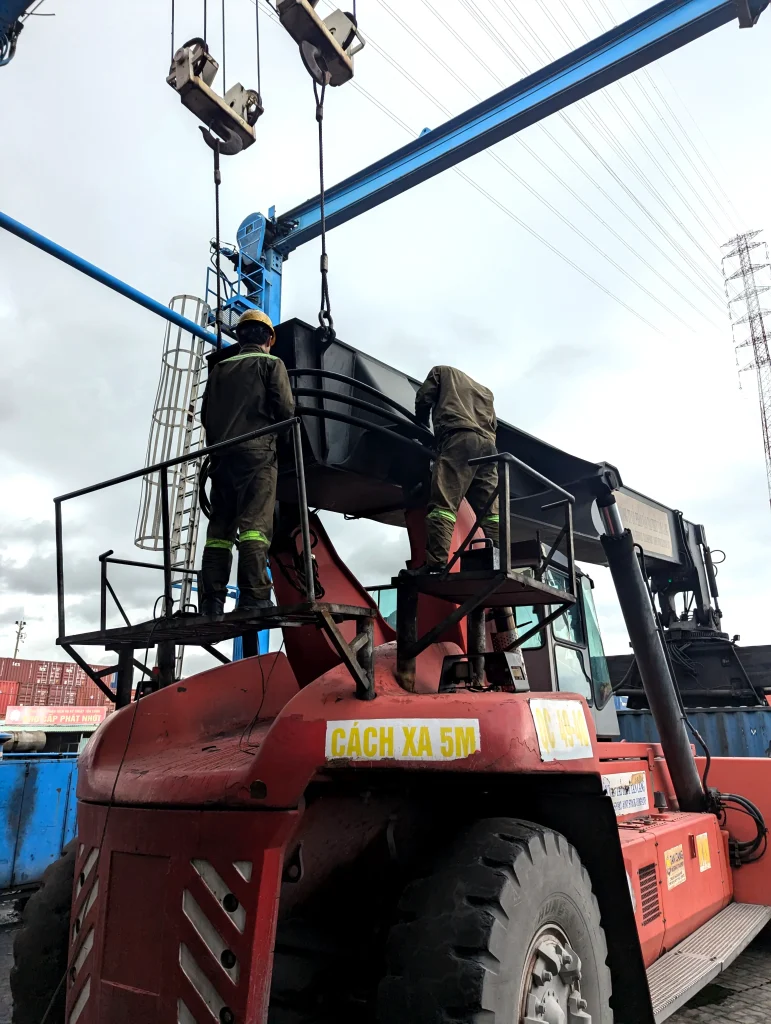
Reach Stackers: Utilize a massive telescopic boom rated for lifting loads up to 45 tonnes and stacking containers up to 5 tiers high. This mechanism includes:
-
Multi-Stage High-Capacity Hydraulic Cylinders: Heavy lift and boom extension cylinders operating under extreme hydraulic pressures.
-
Container Spreader Assembly: A sophisticated electro-hydraulic attachment mounted at the boom head, capable of rotating, side-shifting, and telescoping to engage various ISO container dimensions. The spreader integrates numerous sensors, directional valves, twistlock interlocks, and mechanical linkages. Specialized models also include tilting spreaders for bulk commodity discharging.
-
Technical Requirements: Servicing this system demands advanced knowledge of ultra-high-pressure hydraulics, precision structural alignment, and stringent calibration skills to guarantee absolute safety when hoisting 45-tonne loads at significant heights.
-

2. Electrical & Control Architecture: Basic Relays vs. Complex CAN-Bus Electronic Networks
-
Conventional Forklifts: Electrical circuitry is typically simple, primarily dedicated to starter ignition, basic lighting, and rudimentary solenoid controls.
-
Reach Stackers: Function as a mobile digital control center:
-
CAN-Bus Network: A high-speed multi-node communication bus linking all electronic control units (ECUs)—engine management, transmission, hydraulic valves, and boom load moment indicators.
-
Extensive Sensor Network: Load moment limiters, boom angle/length transducers, chassis inclination sensors, twistlock status sensors, and anti-tilt monitoring. Unlike a mobile crane that remains stationary on outriggers during hoisting, a reach stacker can pick up a 45-tonne container and travel across the terminal yard. Achieving this safely requires continuous real-time computation by electronic controllers to balance dynamic mobility and structural stability.
-
Technical Requirements: Fault troubleshooting cannot be executed by visual inspection or basic multimeters alone. Modern machines strictly require OEM diagnostic software suites and specialized technicians capable of reading CAN telemetry, identifying faulty sensor nodes or modules, and detecting latent mechanical/structural risks before catastrophic failures occur. Given that reach stackers lift up to 45 tonnes via extended booms, any latent defect can quickly escalate into a catastrophic failure.
-
3. Operational Scale & Safety Protocols:
-
Conventional Forklifts: Maintenance can be performed in standard workshop bays using basic hand tools and workshop hoists, with manageable risk parameters.
-
Reach Stackers:
-
Dedicated Workshop Footprint: Requires an expansive, reinforced concrete service yard equipped with heavy-duty rigging gear.
-
Auxiliary Lifting Equipment: Demands overhead gantry cranes, auxiliary mobile cranes, and specialized tire handlers to safely dismantle massive components such as industrial tires, counterweights, boom sections, spreaders, heavy engines, and transmissions.
-
Safety & Precision as Absolute Priority: A minor calibration error in the hydraulic relief system or load moment sensor can cause machine tip-over, resulting in severe structural destruction, cargo loss, or fatal personnel injuries.
-
Visual Comparison: Conventional Forklift vs. Reach Stacker Maintenance
| Maintenance Parameter | Conventional Forklift | Reach Stacker |
| Technician Competency | Requires standard mechanical and basic low-pressure hydraulic skills. | Requires deep expertise in high-pressure hydraulics, complex electronics (CAN-bus), heavy mechanics, and large-scale structural engineering mindsets. |
| Diagnostic Tools & Equipment | Standard mechanical tools, basic electrical multimeter. | Mandatory OEM proprietary diagnostic software, laptops, shaft alignment gauges, ovality micrometers, ultrasonic structural NDT testing… |
| Spare Parts | Common, readily available, relatively low cost. | Specialized, often requires lead-time ordering, substantial capital value. |
| Repair Turnaround Time | Relatively fast for routine faults. | Complex, requiring extensive diagnostic and overhaul time, especially for severe structural and hydraulic defects. |
| Consequences of Servicing Error | Component damage, minor throughput degradation. | Catastrophic accidents, vehicle tip-over, massive cargo and financial destruction. |
Risks and Economic Viability
The comparison clearly illustrates that self-servicing or contracting inexperienced third parties for reach stacker maintenance is an immense gamble. While attempting to trim modest upfront costs, businesses expose themselves to severe operational liabilities:
-
Misdiagnosis: Results in replacing functional parts unnecessarily, inflating repair expenses while leaving root electro-hydraulic faults unresolved.
-
Extended Unscheduled Downtime: Lacking diagnostic tooling, specialized rigging gear, and dedicated spare parts supply networks can turn days of repair into weeks of idle yard capacity.
-
Severe Workplace Safety Hazards: As heavy machinery where individual assemblies weigh multiple tonnes, disassembly and rigging carry substantial hazards for personnel if performed by untrained or uncertified mechanics.
- Sub-Scale Investment Inefficiency: Investing in dedicated OEM diagnostic software, calibration tools, and specialized in-house technical assurance teams without sufficient fleet scale leads to inflated overhead without achieving operational economies of scale.
At Tan Cang Technical Services (DVKT), we take pride in our certified engineering team specializing in both conventional forklifts and complex container reach stackers. We invest in advanced OEM diagnostics, rigorous technical standards, and professional workflows to ensure your lifting fleet operates at peak availability, efficiency, and safety.
Do not let your reach stacker fleet suffer from misdiagnosis. Entrust your heavy machinery to genuine industry experts!
Contact us today to receive:
-
Free Technical Consultation on your fleet’s operating condition.
-
Transparent, Detailed Quotations for tailored maintenance and major overhaul packages.
-
Scheduled Comprehensive Inspections conducted by our certified senior port engineers.
Hotline: 0358141730
Email: dvkt@tancangtech.vn
Website: tancangtech.vn
Tan Cang Technical Services Joint Stock Company – Service Quality for Sustainable Development