Gantry cranes are vital heavy-lifting equipment serving as the backbone across numerous industries, from manufacturing and construction to freight transport and seaport operations. With the capacity to handle oversized and overweight cargo, gantry cranes represent an indispensable solution that empowers enterprises to optimize operational efficiency, accelerate cargo handling throughput, and ensure workplace safety.
This article delivers an end-to-end overview of gantry cranes, ranging from fundamental mechanical structures and common classifications to operating principles and real-world industrial applications.
1. Structure of Gantry Cranes: Core Components
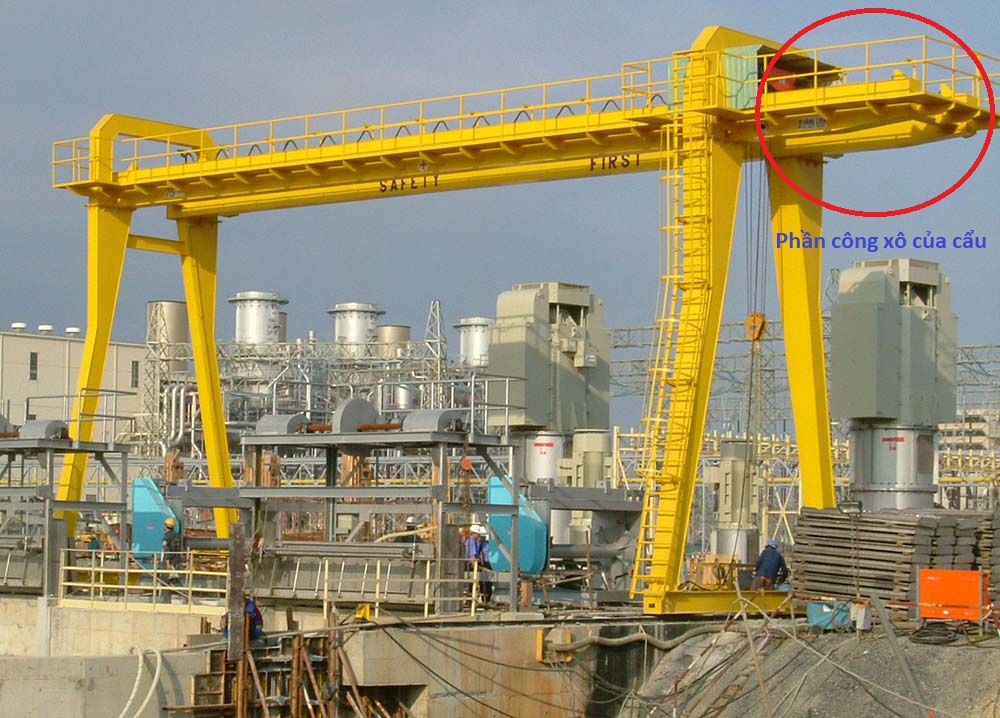
Essentially, a gantry crane is a variant of an overhead crane, engineered to operate independently without relying on the building’s runway beam system. Its structure resembles a robust, freestanding mobile portal.
A standard gantry crane comprises the following key components:
-
Main Girder: The primary load-bearing structure. Depending on the lifting capacity and span, the main girder can be configured as a single-girder gantry crane (one girder) or a double-girder gantry crane (two parallel girders). Double girders are generally selected for heavy-duty lifting requirements and high stability.
-
Gantry Legs (Supporting Legs): Tasked with supporting the entire main girder structure and the suspended load. Legs are commonly engineered in an A-frame design to enhance structural rigidity and evenly distribute loads.
-
Hoisting Mechanism (Hoist or Trolley): This is the “heart” of the gantry crane, executing the lifting and lowering of loads. This assembly includes the hoist motor, gearbox/reducer, wire rope drum, and hook block, traveling horizontally along the main girder.
-
Gantry Travel Mechanism: Enables the entire gantry crane to travel along the working runway or yard. This system can utilize steel wheels traveling on rails (RMG – Rail-Mounted Gantry crane) for high precision, or rubber tires (RTG – Rubber-Tyred Gantry crane) for superior operational flexibility.
-
Electrical System and Control Panel: Supplies power and governs all operations of the equipment. The system comprises electrical control enclosures, variable frequency drives (inverters ensuring smooth motor speed control), cable festoon/reeling systems, and safety interlocks.
-
Control Devices: Operators can control the gantry crane through multiple interfaces: an elevated operator cabin, wireless radio remote control, or a pendant push-button station.

2. Common Classifications of Gantry Cranes
Gantry cranes feature diverse structural designs to fulfill varying operational requirements. Below are the most prevalent classifications:
Classification by Structure and Design:
| Gantry Crane Type | Key Features & Characteristics |
| Single-girder gantry crane | Comprises 1 main girder, suitable for small to medium lifting capacities (1–20 tons), offering low initial investment costs. |
| Double-girder gantry crane | Comprises 2 main girders, delivering high structural stability and heavy-duty lifting capacity (up to 500 tons). |
| Semi-gantry crane | Features supporting legs on one side, while the opposite side travels on an elevated runway beam mounted to the building wall, optimizing floor space effectively. |
| Luffing / Gate-leg gantry crane | Features high, narrow portal legs, commonly used in hydroelectric power plants for intake gate and sluice lifting. |
| Cantilevered / Non-cantilevered gantry crane | Cantilevers extend the main girder beyond the gantry legs, expanding the working reach without relocating the entire crane structure. |
Classification by Travel Mechanism and Application:
-
RTG Cranes (Rubber-Tyred Gantry Cranes): Purpose-built for handling containers in container terminals and ICD yards, featuring high mobility and flexible lane changes.
-
RMG Cranes (Rail-Mounted Gantry Cranes): Also dedicated to container handling but traveling on fixed rails, powered by the electrical grid, environmentally friendly, and ideal for yard automation.
-
Manual Push Gantry Cranes: Compact, low-capacity units moved manually, widely used in smaller workshops and maintenance bays.
-
Shipbuilding Goliath Cranes: Feature colossal dimensions and ultra-heavy lifting capacity, dedicated to assembling mega ship hull blocks and modules.
(Visual reference: Gantry crane classifications: single-girder gantry crane, RTG crane, and semi-gantry crane)
3. Operating Principles and Essential Safety Features
Fundamental Operating Principles
Gantry cranes operate based on coordinated electric motor drives. When the operator inputs commands, the electrical control enclosure supplies power to the corresponding motors:
-
Hoisting motor: Rotates the rope drum to payout or take up wire rope, lifting or lowering the crane hook.
-
Trolley traverse motor: Drives the trolley (carrying the hoist mechanism) along the main girder span.
-
Gantry travel motor: Propels the entire crane structure along the rail tracks or runway area.
Variable frequency drive (VFD) systems play an essential role in ensuring smooth starts and deceleration, dampening load swinging, minimizing mechanical vibration, and extending equipment service life.
Essential Safety Features
For modern gantry cranes, safety is the foremost priority. Mandatory safety devices include:
-
Overload Protection Sensors: Automatically cut off hoisting operations if the load exceeds rated lifting capacity.
-
Electromagnetic Fail-Safe Brakes: Ensure the suspended load is securely held even in the event of power loss.
-
Travel Limit Switches: Prevent the trolley and gantry structure from overtraveling beyond safe operational limits.
-
Sirens and Warning Beacon Lights: Provide audible and visual alarms while the gantry crane is in motion.
-
Anti-Collision Systems: Utilize sensors to prevent gantry cranes from colliding with adjacent cranes or physical obstacles.
4. Applications of Gantry Cranes Across Industries
-
In manufacturing plants and workshops: Lifting and positioning structural steel, heavy machinery, and precast concrete elements.
-
At seaports and ICDs: RTG cranes and RMG cranes serve as the primary equipment for transferring containers between terminal trucks and yard blocks.
-
In the shipbuilding industry: Assembling super-heavy ship hull modules weighing hundreds of tons.
-
In the construction sector: Transporting building materials, launching bridge girders, and erecting tunnel segments.
-
In open-air stockyards: Stacking and handling structural steel, coils, and bulky cargo without requiring covered warehouse structures.

Handover and commissioning of RMG crane for Tan Cang
As demonstrated, gantry cranes represent a major capital investment that directly determines an enterprise’s production and logistics throughput. Selecting the appropriate gantry crane tailored to load capacity, span requirements, and operating conditions delivers long-term economic efficiency.
However, particularly for specialized cranes demanding extreme precision, speed, and safety—such as port and ICD-dedicated RTG, RMG, and STS cranes—partnering with an engineering specialist with profound experience is essential.
With years of specialized experience in technical assurance, crane engineering design, erection, and manufacturing of port cargo handling equipment, Tancangtech is fully confident in delivering gantry crane solutions optimized for operating environments in Vietnam. We not only supply equipment but also partner with our clients through dependable warranty and preventive maintenance policies, ensuring your machinery consistently operates at peak availability.
Contact Tancangtech today for in-depth engineering consultation on gantry crane design, erection, and manufacturing solutions tailored to your enterprise!