Colossal STS cranes (Ship-to-Shore) and RTG cranes (Rubber-Tyred Gantry) stand as icons of power and efficiency in modern container ports. Yet, behind this monumental presence lies a frequently underestimated protective barrier: the paint coating system. For port cargo handling equipment, protective coatings are far more than an “aesthetic layer”—they serve as the primary “defensive shield” determining structural longevity, operational safety, and reliability for multi-million-dollar asset systems.
Enhancing Aesthetics and Protecting the Structural Integrity of Port Handling Equipment

Port cargo handling equipment operates under extreme environmental conditions, exposed to relentless rain, sun, severe weather fluctuations, and particularly highly corrosive marine atmospheres—a reality made even harsher in tropical climates. Without disciplined and standardized technical assurance, equipment rapidly degrades, posing severe safety hazards and aesthetic degradation.
Continuous Corrosion: Coastal marine air contains high concentrations of airborne sea salts, forming a potent electrolyte solution that accelerates electrochemical oxidation (rusting) exponentially compared to inland environments. Harsh solar UV radiation causes photodegradation, chalking, and discoloration of topcoats, while near-saturated humidity continuously penetrates micro-crevices, placing structural steel under constant threat.
Mechanical Stress: Continuous container handling, high-speed travel, and dynamic hoisting generate microscopic material flexing and cyclic vibration. These forces induce micro-cracks across the coating surface, opening ingress pathways for corrosive agents.
The Critical Vulnerability – Welded Joints: Welded seams represent the “Achilles’ heel” of structural steel. The welding thermal cycle alters the steel’s microstructure within the Heat-Affected Zone (HAZ), making it considerably more susceptible to galvanic corrosion. If the coating in these areas is compromised, corrosion penetrates rapidly, propagating undetected beneath the paint film and causing severe blistering and delamination.
The consequences of coating failure extend far beyond unsightly aesthetics. As structural steel corrodes, the equipment’s load-bearing capacity deteriorates significantly. Localized phenomena such as pitting corrosion can bore deep cavities, critically weakening stress-concentrated joints and introducing catastrophic risks of structural fracture, buckling, or sudden deformation under peak operational loads.
Inspection of Port Equipment Coatings and Timely Engineering Interventions
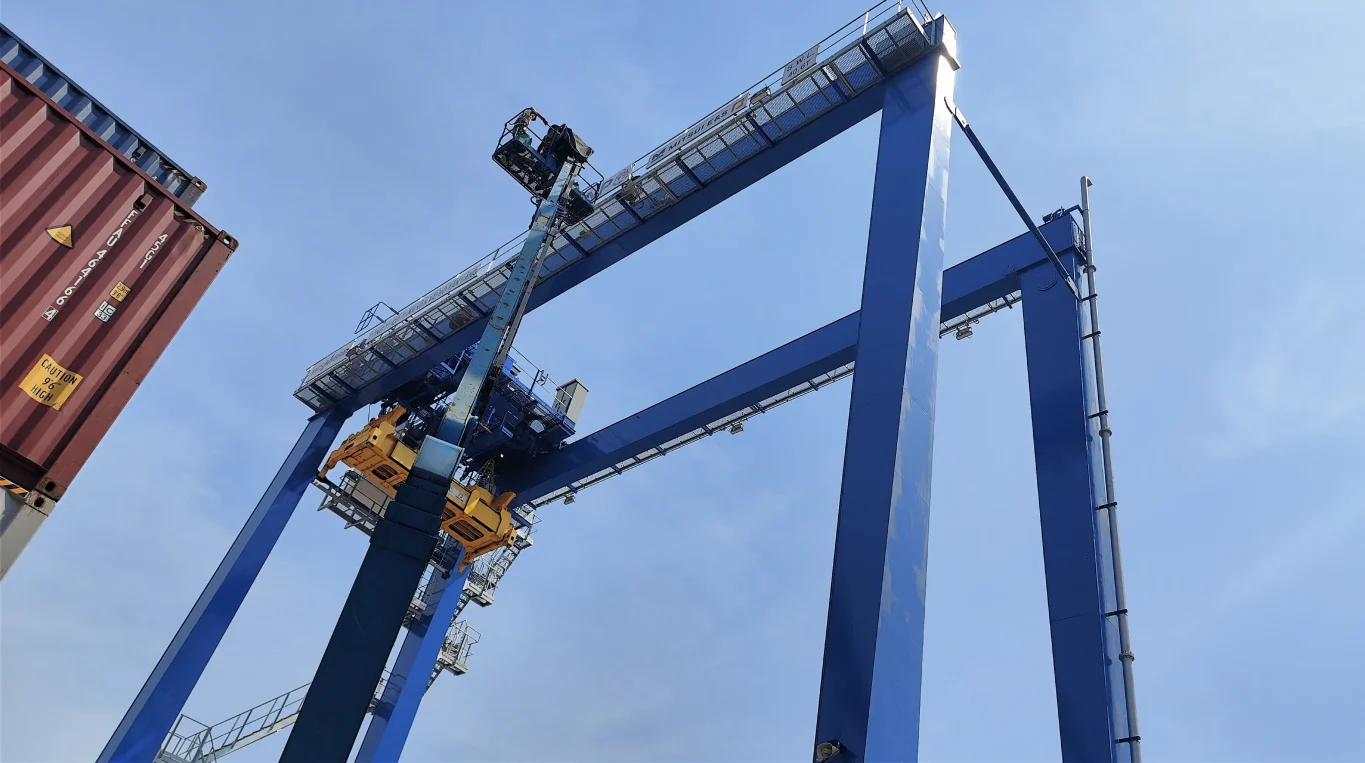
Over time, coating degradation is inevitable. Routine inspection and preventive maintenance are vital to extending equipment asset life. Below are common approaches:
1. Visual Inspection
– Lowest cost: Requires no expensive instrumentation.
– Fast and flexible: Can be conducted frequently by on-site technical teams.
– Detects obvious defects: Blistering, flaking, peeling, surface rust, and topcoat chalking.
– Low precision: Heavily reliant on inspector experience.
– Overlooks micro-defects: Ineffective for detecting micro-cracks, pinholes, or gradual dry film thickness reduction.
2. Specialized Instrument Testing
– High accuracy: Delivers quantitative data (film thickness, adhesion strength).
– Uncovers hidden defects: Holiday / pinhole detectors identify microscopic voids invisible to the naked eye.
– Basis for asset planning: Provides empirical data to plan comprehensive blasting and repainting schedules.
– Higher expenditure: Requires investment in calibrated testing devices and specialized personnel training.
– Time-intensive: Thorough non-destructive testing takes longer to execute.
3. Early Intervention and Spot Repair (Touch-Up)
– Cost-effective: Treats localized damage without requiring full-crane repainting.
– Minimal downtime: Significantly shortens equipment turnaround time.
– Aesthetic variation: Newly applied touch-up areas may display subtle color or gloss variation compared to aged coatings.
– High risk if surface preparation is substandard: Failure to completely eradicate rust will cause early localized re-failure.
Perspective and Recommendations from Tan Cang Technical Services (DVKT)
In Vietnam’s seaport system, operating environments are exceptionally aggressive—especially for offshore terminals and river mouth ports exposed to high winds, humidity, and elevated salinity far exceeding inland berths. Coating inspection and maintenance must be performed more rigorously. To balance lifecycle costs with operational risks, DVKT recommends regular visual inspections combined with localized touch-ups and comprehensive non-destructive testing every 1–2 years.
- Port terminals must ensure all personnel recognize heavy handling assets as strategic operational “materiel”—particularly STS, RTG, and quayside cranes. This requires close collaboration across all teams: crane operators, duty supervisors, maintenance crews, and stevedores, maximizing the probability of identifying early coating defects and mechanical issues.
- Deploy technical inspection teams on weekly/monthly visual rounds to catch early warning signs of coating deterioration.
- Rapid intervention: Immediately upon identifying localized blemishes or micro-rust, execute spot touch-ups to arrest corrosion spread. Log temporary defect coordinates and photographic records prior to coating repair for quality audit tracking.
- Schedule specialized instrument inspections every 1–2 years for high-stress zones (crane legs, main girders, critical structural welds) to assess overall coating integrity and determine full multi-coat refurbishment cycles (primer, intermediate, and topcoat systems).
Key Engineering Insights by DVKT for Repainting Port Cargo Equipment
Repainting port heavy equipment is never a matter of merely brushing on fresh paint; to preserve structural safety, it is a complex engineering procedure:
Surface Preparation: The paramount step—accounting for 70% of coating longevity. The substrate must be thoroughly cleared of grease, chemical contaminants, dust, mill scale, rust, and degraded old paint.
Selecting the Proper Coating System: High-performance marine industrial coatings certified for ISO 12944 C5-M (Very High Marine Corrosivity) environments are mandatory. A standard specification comprises 3 layers:
- Primer: Zinc-rich epoxy primer (Epoxy Zinc-Rich Primer) for cathodic electrochemical corrosion protection.
- Intermediate coat: High-build epoxy coat (High Build Epoxy) to provide barrier resistance against moisture permeation and mechanical impact.
- Topcoat: Polyurethane (PU) topcoat providing superior UV resistance, color retention, and gloss finish.
Optimal Climatic Application Conditions: Never apply coatings during rain, ambient relative humidity > 85%, or when the steel substrate temperature is less than 3°C above the ambient dew point (preventing moisture condensation that compromises adhesion).
Controlling Dry Film Thickness (DFT): Each coat must strictly achieve manufacturer-specified DFT ranges. Insufficient DFT yields inadequate barrier protection, while excessive DFT induces brittleness, cracking, and solvent entrapment.
Quality Assurance and Evaluation Criteria
To ensure coating maintenance meets international standards, quality acceptance must rely on rigorous quantitative criteria, not subjective visual impressions alone.
Surface Cleanliness: Visual comparison with ISO 8501-1 pictorial standards. A minimum blast cleaning grade of Sa 2.5 is strictly required (Near-white metal blast cleaning with residual staining not exceeding 5% of surface area).

Dry Film Thickness (DFT) Verification: Conducted using calibrated magnetic or eddy-current gauges in accordance with SSPC-PA2 protocols, governing reading frequencies, measurement spot densities, and acceptable tolerance limits.
Adhesion Strength Testing: Evaluated via Cross-Hatch Tape Testing (ASTM D3359). A precision lattice pattern is cut through the film, adhesive tape is applied and peeled off, and adhesion is rated based on flaking percentage.

Holiday / Pinhole Detection: High-voltage or wet sponge holiday detectors inspect for microscopic voids, pinholes, and discontinuities invisible to the naked eye—critical for anti-corrosion primer and barrier coats.
Investing in protective coatings and structured paint maintenance for port cargo handling equipment is not an overhead expense, but a strategic investment in safety, durability, and operational longevity. A high-performance coating system, applied and maintained in strict compliance with technical standards, saves terminal operators millions of dollars in major repairs, preserves corporate brand reputation, and ensures heavy assets maintain high residual value over decades.