Recent geopolitical volatility, particularly escalating tensions in the Middle East (Source: [WorldCargo News – Middle East Tensions Surge]), continues to deliver severe shocks to global energy supply chains. The inevitable consequence is persistent fuel price volatility, exerting massive cost pressures on port and terminal operators – enterprises that currently maintain the vast majority of their mobile cargo handling fleets on diesel engines.
In practice, whenever global energy supplies are disrupted, soaring operational expenditures (OPEX) directly erode the profit margins of terminal operating businesses. Confronted with this systemic risk, from an engineering and technical standpoint, we must rigorously re-evaluate current cargo handling equipment selection criteria. What is the truly strategic technological solution to help seaports attain operational self-reliance and high reliability, rather than continuing to gamble investment returns on unpredictable oil price spikes?
-
The Impact of Geopolitical Conflicts & Energy Price Shocks on Port Operations
Consider this calculation: in a container yard operating entirely on diesel-powered RTG cranes idling and revving day and night—even when not actively hoisting containers, floodlights, auxiliary electrics, horns, and air conditioning battling 37°C ambient temperatures remain constantly active—what percentage of total OPEX is consumed by fuel? When fuel supply chains are disrupted and diesel prices escalate by 30–50%, transport and stevedoring costs inflate exorbitantly. Practical experience in Vietnam has demonstrated diesel prices reaching up to 50,000 VND/liter at peak times—a sobering benchmark for port operators.
Likewise, while the Government’s green port development policy may have a multi-year transition horizon, the decarbonization roadmaps of global shipping lines are already active, prioritizing port calls at certified green terminals that comply with strict carbon emission reductions.
-
Selecting the Right Container Handling Equipment Stack
Facing the risk of fuel supply chain disruptions, container handling equipment standards must be placed under thorough technical scrutiny. Which option represents the ultimate answer?
- Diesel RTG (Traditional Diesel-Powered Rubber-Tyred Gantry Crane): The basic structural design of an RTG crane is relatively straightforward with fewer complex transmission modules, making it thoroughly familiar to mechanical technicians. However, maintaining an exclusively diesel RTG fleet today imposes immense fuel cost burdens and heavy carbon emissions.
- Reach Stacker (Forklift / Container Handler):
- Diesel Version: Highly maneuverable across every nook and corner of ports and ICDs, but consumes fuel at high rates. While total fuel consumption is lower than an RTG, the trade-off is reduced container stacking density and longer cycle handling times.
- Electric Version (EV Reach Stacker): While electric forklifts are widespread in warehouse and factory environments to meet indoor emission standards, heavy-duty electric reach stackers operating outdoors remain an open question requiring comprehensive field evaluation, particularly under Vietnam’s tropical monsoon climate with high ambient humidity.
- eRTG (Electrified RTG – Powered via Cable Reel or Vahle Conductor Busbar): This is the most compelling strategic solution today. Instead of relying on onboard diesel fuel, the eRTG draws power directly from the port’s substation grid (except when power source failures occur), virtually eliminating sensitivity to oil prices and saving up to 80–90% in energy costs. Energy expenditure is stabilized and mechanical maintenance is significantly reduced because primary power stems from the electrical grid. Today, this stands as nearly the most comprehensive solution—but is it universally suitable for every terminal?
-
Should Your Port Invest in eRTG Cranes?
Drawing from extensive hands-on expertise—from technical assurance, equipment mastering, and custom retrofitting to operational demands, to becoming one of the direct domestic manufacturers of RTG cranes in Vietnam—Tancangtech shares essential technical perspectives and considerations before investing in an eRTG crane fleet.
While eRTGs offer breakthrough efficiency and sustainability, capital investment decisions require rigorous multi-dimensional evaluation:
- Recognize that eRTG is primarily a high-density container handling solution: In practice across Saigon Newport Corporation (SNP) terminals, eRTGs unleash their full power only when operated synchronously within an integrated port ecosystem, leveraging economies of scale. The eRTG then becomes a vital link in optimizing yard storage density and accelerating vessel turnaround times as cargo throughput surges. For regional terminals where yard density and cycle speed are not primary operational bottlenecks, investing in RTGs or eRTGs may not be immediate; a 45-ton reach stacker capable of handling both containers and general cargo with lower upfront CAPEX may prove safer and more capital-flexible.
- Power Grid Infrastructure & Substations: Terminal operators must evaluate whether their existing medium-voltage grid is sufficiently stable. Voltage drops or unconditioned power will immediately trigger eRTG Inverter/PLC drive faults, since the electrical grid is the crane’s primary lifeblood. Furthermore, substation capacity must be engineered for future multi-crane scaling without necessitating extensive civil reconstruction.
- Yard Civil Works Quality & Pavement Integrity: Can your container yard pavement maintain strict flatness over the next 2–3 years? Uneven runway settlement or pavement cracking can severely impair gantry steering and container positioning, induce structural fatigue on the crane framework, and introduce operational hazards, as RTGs—and eRTGs in particular—rely heavily on level runway civil works.
- Technical Workforce Competence: Can your current port or ICD engineering staff transition smoothly to electrical and electronic automation? Or will you need large-scale recruitment for industrial electrical systems, automation, and medium/low-voltage technicians? Port operators must account for workforce transition when procuring electrified crane fleets at scale.
- Rapid Emergency Response Capabilities: Because eRTGs rely almost entirely on the power grid (with certain variants equipped with auxiliary diesel generators or battery packs for bay crossing), any electrical tripping event can halt operations. Are your engineering staff and spare parts supply chains equipped for rapid troubleshooting and minimal downtime?
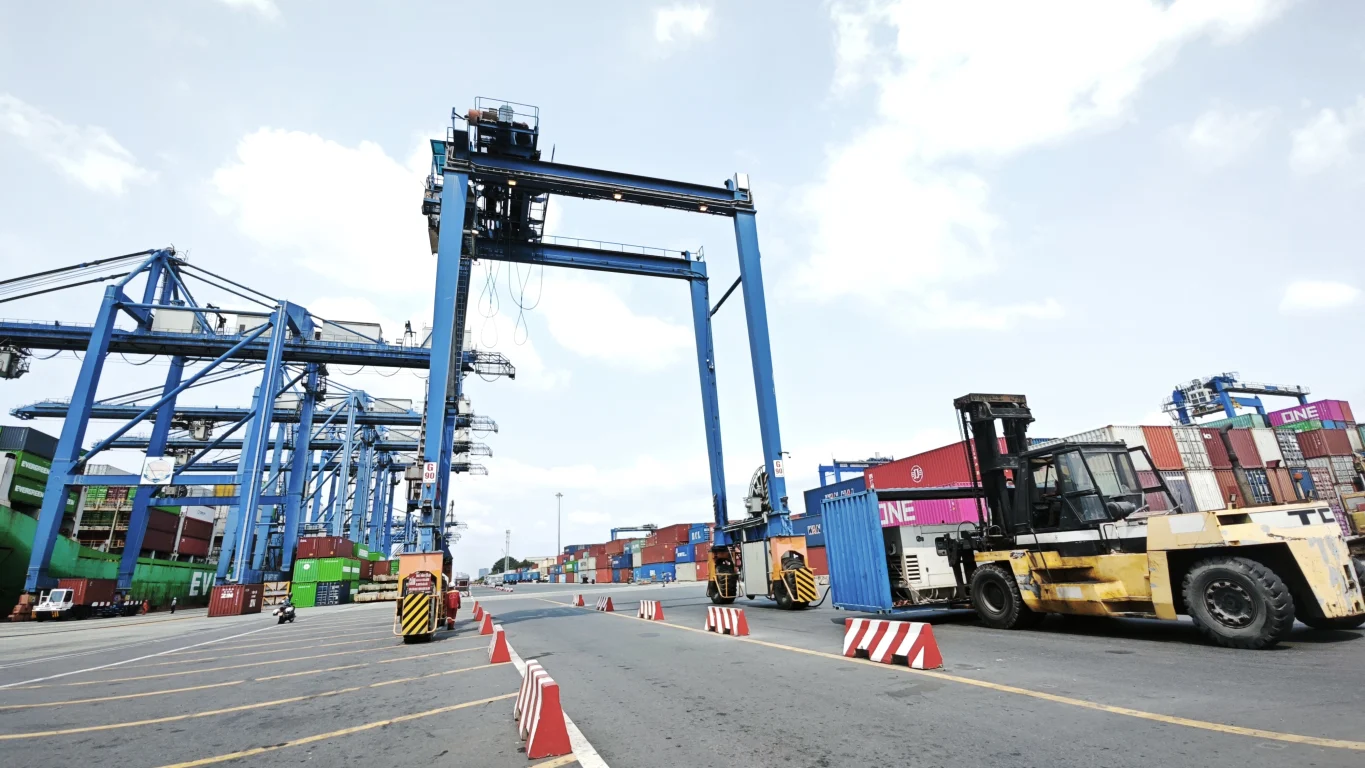
Relocating eRTG crane to new operational yard block - Operating Environment in Vietnam: Tropical monsoon climates characterized by high ambient temperatures, heavy rainfall, and corrosive maritime salinity represent continuous challenges for electrical switchgear and mechanical components. In addition, high-intensity operational cultures prioritizing throughput require rigorous preventive maintenance practices, particularly for advanced electrified assets like eRTGs.
- And numerous other site-specific engineering variables.