Drawing upon years of specialized engineering experience in port material handling equipment, I am pleased to share an in-depth technical analysis of Ship-to-Shore (STS) quayside container cranes—the monumental machinery widely recognized as the ‘backbone’ of every modern container terminal. Selecting an STS crane system is far from a routine procurement decision; it represents a strategic capital investment that defines a terminal’s competitive edge, operational throughput, and long-term sustainability for decades to come.
This article delves into key engineering characteristics, critical technical specifications, and strategic industry perspectives on STS cranes.
The Vital Role of STS Cranes
An STS crane is a massive, specialized machine engineered for container loading and unloading between berthed vessels and the quay. The efficiency of the entire maritime supply chain hinges directly upon the hoisting speed, operational stability, and level of automation of the STS crane fleet. An optimally configured STS crane fleet directly accelerates gross berth productivity (moves/hour), minimizes vessel turnaround time at berth, and substantially enhances the port’s commercial attractiveness to major global shipping lines.
Furthermore, unlike mobile yard handling equipment that can be readily relocated or substituted during breakdowns, an STS crane operates strictly on fixed quayside rails. Any unexpected breakdown can severely disrupt vessel turnaround schedules. Consequently, STS cranes are engineered with an uncompromising emphasis on operational reliability and structural integrity.
Key Technical Characteristics
1. Heavy-Duty Specialized Steel Structure
The crane structure is a sophisticated welded steel assembly designed to withstand extreme dynamic fatigue loads, heavy gale-force winds, and aggressive marine corrosion. Major structural assemblies include:
- Gantry Frame (Portal): The heavy portal frame traveling along the quayside crane rails.
- Main Boom & Girder: Extends seaward over the vessel beam to access container cell guides, featuring a boom-hoist mechanism (booming up) to provide vertical clearance during vessel docking and unberthing. A primary objective among crane manufacturers is reducing deadweight while maximizing outreach through optimized structural geometry, higher-tensile steel, or advanced composite designs.
- Trolley: Traverses along the boom/girder carrying the spreader to transfer containers between vessel and landside transfer lanes.
- Spreader: The direct container engagement attachment, capable of telescoping between standard ISO container sizes (20ft, 40ft, 45ft) and frequently configured for twin-lift operations (handling two 20ft containers simultaneously).
2. Advanced Electrical Drive & Control Architecture:
-
AC Variable Frequency Drive (VFD): Modern STS cranes utilize 100% AC electric drives powered by variable frequency inverters, delivering precise speed modulation, smooth motion control, and high energy efficiency.
-
Central Automation & CMS System: Complete crane functionality is coordinated by Programmable Logic Controllers (PLC) paired with an integrated Crane Management System (Crane Management System – CMS). This architecture not only controls motion kinetics but also performs automated fault diagnostics, real-time condition monitoring, and predictive maintenance scheduling on contemporary cranes.
3. Advanced Safety & Operator Assistance Technologies:
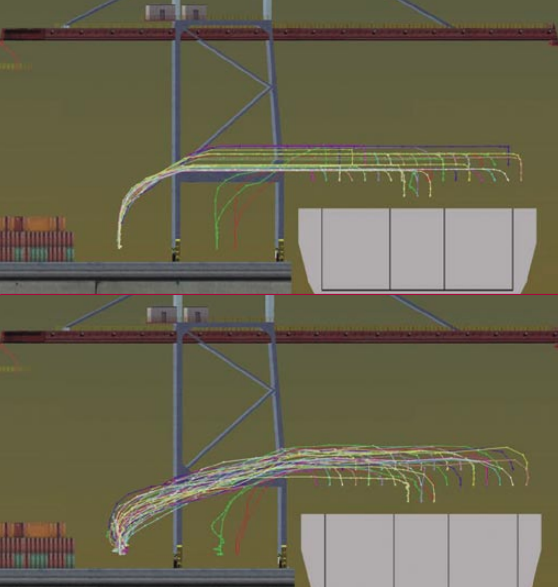
Safety and operational uptime are paramount. STS cranes are equipped with comprehensive active safety systems to protect personnel and high-value terminal assets:
-
Anti-Sway & Spreader Positioning: Suppresses container pendulation during trolley motion, facilitating rapid, precise landing by the operator.
-
Anti-Collision Systems: Laser, radar, and optical sensors prevent collisions between adjacent cranes, between crane boom and vessel superstructure, or with quayside obstacles.
-
Overload Protection System: Provides instantaneous load cell monitoring to prevent over-capacity hoisting during container handling.
- Semi-Automation & Driver Assistance: Dynamically computes optimized container transfer trajectories, automatically aligns the spreader over target slots, and maps on-vessel container profiles.
- Auxiliary Protective Sensors: Slack-rope detection, overcurrent/earth fault protection, structural vibration sensors, and storm pin interlocks.
Core Technical Specifications to Evaluate
When procuring or evaluating new or refurbished STS cranes, port engineers and asset managers must assess the following core parameters:
| Technical Parameter | Description and Operational Significance | Typical Benchmark |
| Safe Working Load (SWL) | The maximum rated safe hoisting capacity of the crane (while cranes possess mechanical safety factors allowing greater loads, in specific qualified engineering scenarios technicians can recalibrate ratings within 10–15% over rated SWL under strict control). Governs the ability to handle heavy container loads and tandem-lift operations (two 40ft containers simultaneously). | 50 tonnes, 65 tonnes (standard), 80-100 tonnes (for tandem lift) |
| Outreach | The maximum horizontal reach of the boom measured seaward from the seaside rail centerline. This parameter dictates the maximum vessel beam and container row capacity the crane can service. | 50m (Panamax vessels), 65m (Super Post-Panamax), >70m (Megamax vessels with 24 container rows) |
| Lifting Height | Includes hoisting height above rail level (to clear multi-tier deck container stacks) and lowering depth below rail level (to reach the bottom of deep vessel cargo holds). | 35-40m (above rail), 18-22m (below rail) |
| Rail Span (Rail Gauge) | The center-to-center distance between seaside and landside gantry crane rails along the quay deck. Dictated by quay civil engineering and structural design. | Standard spans: 20m, 30m, 35m |
| Operating Speeds | The primary determinant of gross terminal productivity (moves/hour). | Modern STS crane benchmarks:
– Hoisting/Lowering (rated load): 60-90 m/min – Hoisting/Lowering (empty spreader): 120-180 m/min – Trolley Traversing: 180-240 m/min – Gantry Travel: 45 m/min |
| Power Supply System | STS cranes connect to high-voltage shore power (6.6kV, 11kV, 22kV) via motorized cable reel systems (cable reels). High-voltage power is transformed and regulated inside on-board electrical houses (e-houses) to feed various functional subsystems. |
Future Trends
Given Vietnam’s strategic maritime location adjacent to major international trade routes, expansive coastline, deep-water port potential, and favorable free trade agreements, export volumes and FDI inflows are projected to expand vigorously in the coming years. Furthermore, focused public investment in maritime infrastructure is driving port expansions across coastal provinces, intensifying terminal competitiveness. Terminals seeking to maintain market leadership must invest in service quality, vessel turnaround acceleration, and fleet scalability.
Below are key technological trends in STS crane development that terminal operators should evaluate for strategic investment and upgrades:
- Automation: Semi-automated and fully automated STS cranes are becoming increasingly prevalent worldwide, enabling machines to perform repetitive motion sequences while reserving human intervention for exception handling and critical decision-making. Higher automation levels reduce required on-site headcount while boosting operational consistency. Through rigorous research and industry benchmarking, Tan Cang Tech highlights semi-automation as one of the most practical trends for Vietnamese terminals. Studies demonstrate that semi-automation can elevate handling productivity by 15% to 30%, dramatically bolster quayside safety, and prevent handling collisions.
-
Remote Operation: Rather than working in high-altitude cabins, crane operators control multiple cranes from an ergonomic, centralized Remote Operation Station (ROS). Supported by high-resolution multi-angle camera feeds, operators make fast, precise decisions in a safe, controlled office environment. Typically integrated with comprehensive automated systems, where the remote operator intervenes primarily for non-standard handling scenarios.
-
Energy Regeneration: Regenerative braking technologies capture electrical power generated during container lowering, reducing STS crane energy consumption by 20% to 30%. This delivers direct power savings while supporting green port environmental standards. Moreover, regenerative energy retrofits involve relatively modest capital outlay and can be deployed directly onto existing operational cranes.
- Big Data Applications in Maintenance & Repair: Leveraging big data telemetry during crane operations to transition from routine calendar maintenance to predictive maintenance (PdM). Real-time condition monitoring minimizes equipment downtime, extends component life cycles, and reduces overall spare parts inventory and labor overhead.
Selecting an STS crane system is a multifaceted engineering challenge balancing immediate operational throughput targets with long-term strategic growth. A crane system configured with precise technical specifications matched to target vessel classes, coupled with advanced driver-assist and energy-efficient technologies, forms an invaluable asset delivering peak operational performance and securing prime carrier loyalty.