Author: Wind Power & Renewable Energy Project Management Board – Tan Cang Technical Services Joint Stock Company (Tân Cảng Tech)
—
1. Energy Transition and the Challenge of Out-of-Gauge (OOG) Construction
The boom of the renewable energy sector, especially wind power (both onshore and offshore), is opening a new chapter for Vietnam’s energy infrastructure. To realize Power Development Plan VIII (PDP8), a series of large-scale wind farms are being deployed. However, behind the massive wind turbine blades spinning gracefully in the sky are unprecedented challenges in terms of out-of-gauge (OOG) logistics and precision mechanical installation at heights exceeding 100 meters.
In the wind power construction value chain, the heavy lifting and assembly of equipment (turbines, rotor hubs, blades, and tower sections) represent the highest-risk phases, requiring extremely stringent technical capabilities and cargo handling equipment.
Building upon its position as Vietnam’s leading enterprise in the maintenance and installation of quayside STS cranes and RTG gantry cranes, Tan Cang Technical Services Joint Stock Company (Tân Cảng Tech) has made a strategic shift into the field of wind power installation, demonstrating the capacity of a Vietnamese enterprise to master super-heavy lifting and handling technology.
—
2. Technical Synergy Analysis: From STS/RTG Port Cranes to Wind Turbine Installation
Many project managers ask: Why can a company specialized in port equipment successfully transition to wind power construction?
The answer lies in the deep technical synergies in mechanical engineering, lifting dynamics, and electrical control systems shared by these two types of equipment:
2.1. Super-Heavy Lifting Dynamics and High-Altitude Challenges
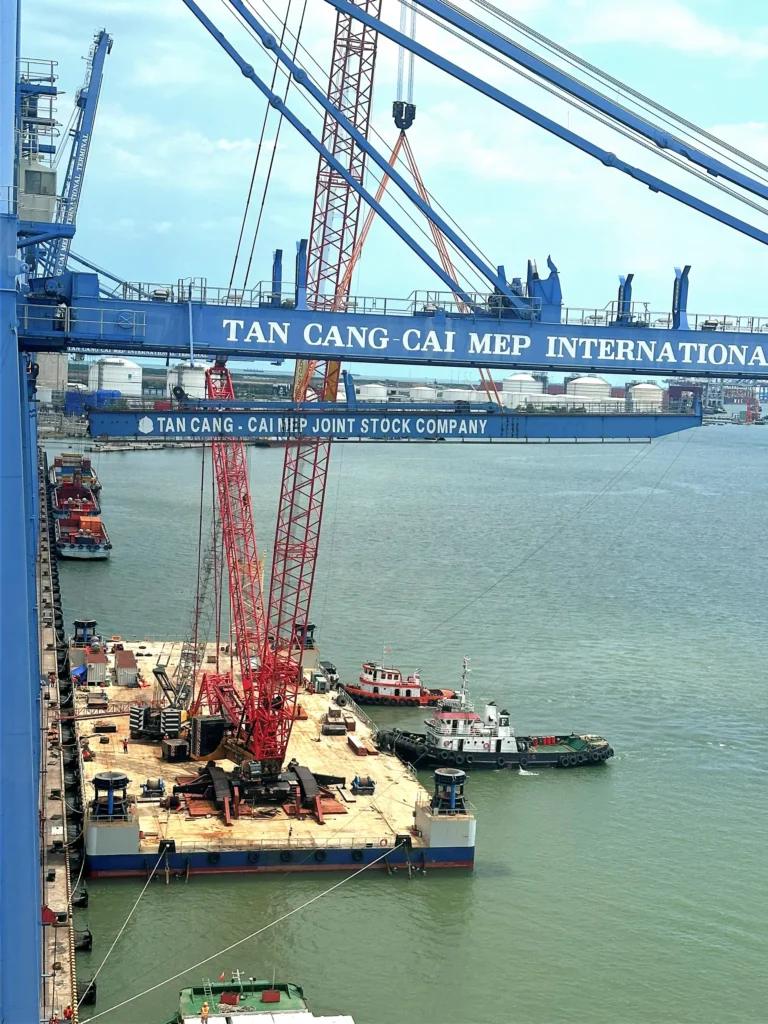
Quayside STS (Ship-to-Shore) cranes are among the largest lifting steel structures in the world, with outreach booms extending over 60 meters and under-hook lifting heights of up to 50 meters, regularly handling container cargo weights of 40 to 80 tons under the influence of sea winds.
Wind turbine construction requires similar lifting techniques but at a much more extreme scale:
- Heavy payloads: The weight of a wind turbine nacelle can range from 80 tons to over 150 tons depending on the capacity (from 3MW to over 6MW), requiring heavy-duty crawler cranes for installation. In major projects for repairs and assembly of STS cranes, we also utilize 800-ton cranes to install quayside beam components, sea beams, and A-frames. Although structural layouts differ, load-balancing calculations, ground bearing capacity analysis, and rigging design are highly similar to wind power construction—often even more complex due to structural constraints.
- Wind loads: At these high elevations (usually 100 to 140 meters), wind speeds and turbulence are significantly higher than at ground level. The wind-resistance surface area of wind turbine blades (lengths ranging from 60 to 85 meters) is immense, generating substantial aerodynamic torsional moments acting directly on the crane hook.
- Dense electrical systems: Turbine electrical systems are densely arranged, using frequency inverters, PLC control systems, etc., requiring experienced technicians for connection and commissioning. This mirrors the complex electrical systems of quayside and yard gantry cranes, where our team has extensive experience in integration, troubleshooting, and testing.
The experience in calculating wind loads, lift cable tension distribution, and anti-tipping stability that Tan Cang Tech accumulated in port crane installation projects is directly and effectively applied to the wind turbine installation workflow.
2.2. Complexity of Power Drive and Electrical Control Systems
Modern STS and RTG port cranes are highly automated machines utilizing frequency inverters, high-power AC motors, and intelligent PLC control systems. A wind turbine is essentially an AC generator operating in the reverse workflow of an electric lift motor, using complex pitch control and yaw control systems.
Tan Cang Tech’s team of experts who master programming and maintenance of medium and low-voltage electrical systems enables us to easily inspect, connect, and commission the internal electro-mechanical systems of wind turbines, ensuring stable operation immediately after physical assembly.
—
3. Core Technical Challenges in Wind Power Installation and Engineering Solutions
In wind power construction, Tan Cang Tech always applies a standardized engineering approach to address the major challenges:
3.1. Challenge 1: Dynamic Load Balancing During Nacelle and Hub Lifting
- Complexity: Lifting a nacelle weighing over 100 tons to a height of 120 meters means even minor wind-induced cable swing can generate massive lateral inertial forces, causing potential deformation of the steel tower sections or overloading the horizontal shear limits of the main crawler crane.
- Tan Cang Tech’s Solution: We apply real-time lifting dynamic simulation software to calculate safe weather windows. Simultaneously, we deploy an elite, highly experienced installation team capable of rapid response and precise adjustments to capture the optimal wind conditions.
3.2. Challenge 2: High-Altitude Single Blade Installation
- Complexity: Lifting the entire rotor assembly (hub and 3 pre-assembled blades) requires a huge ground area and extremely large cranes. The single blade installation method saves space but demands absolute precision during high-altitude blade alignment. We believe this is the future of wind power assembly as turbine sizes continue to grow (the bigger, the better), making ground pre-assembly increasingly impractical for onshore wind projects with restricted sites.
- Tan Cang Tech’s Solution: We work directly with wind turbine manufacturers to master specialized blade rigging equipment and have developed in-house mechanical tools to support single blade lifting methods.
3.3. Challenge 3: Out-of-Gauge (OOG) Logistics Integrated with Port Operations
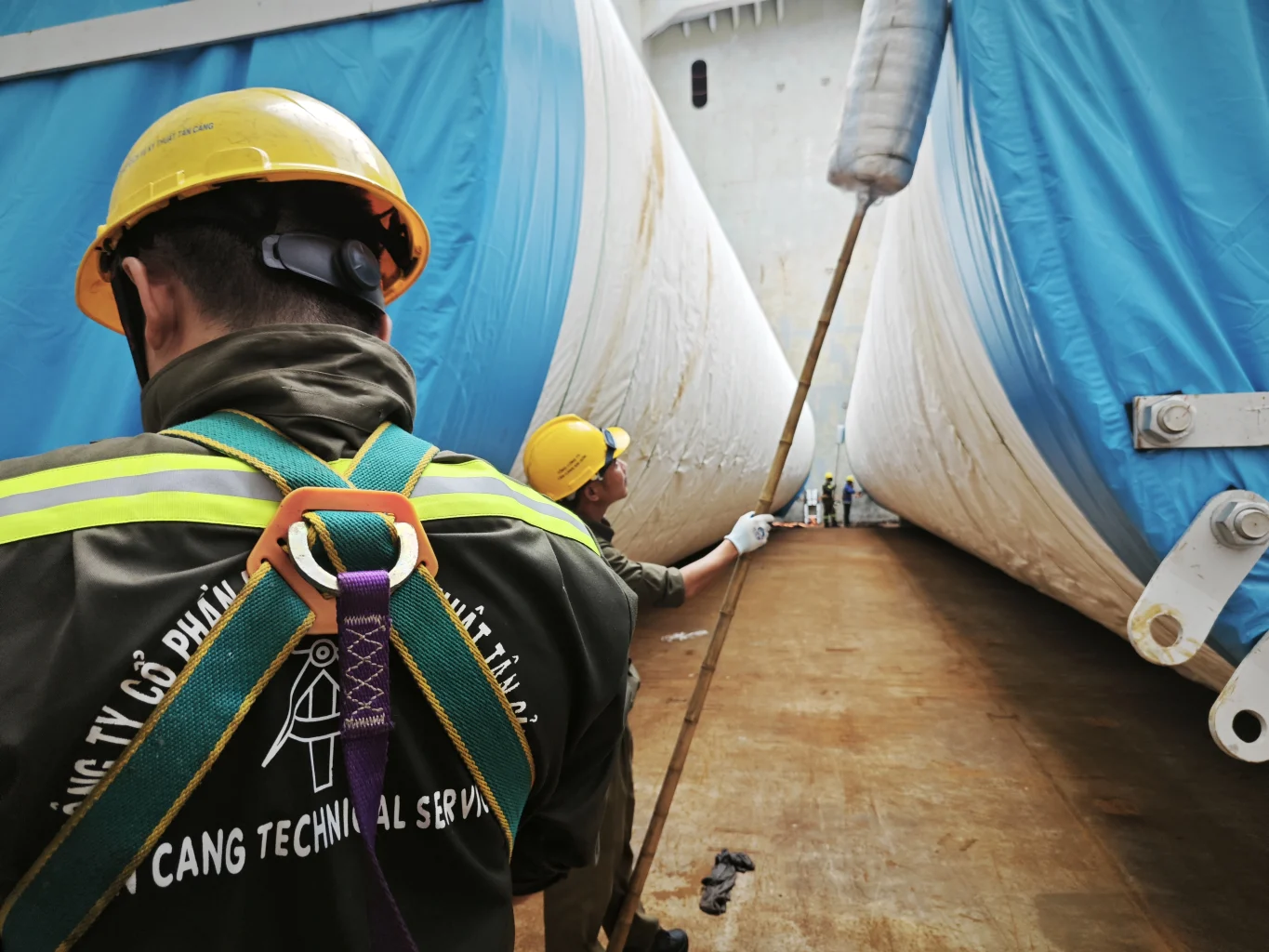
- Analysis of Risk: Wind turbine blades exceeding 70 meters and tower sections weighing hundreds of tons cannot be transported via standard road networks. Receiving equipment from ocean vessels, staging at terminal yards, and barge transport to site requires dedicated port infrastructure.
- Tan Cang Tech’s Solution: Leveraging our position as a member of Saigon Newport Corporation, we coordinate loading/unloading capabilities at deep-water terminals and deploy large barge fleets to transport components safely to the construction site. Read more in our article about wind power cargo handling at Tan Cang Cam Ranh.
3.4. Challenge 4: Deploying High-Quality Personnel at Remote Sites
- Complexity: Meeting safety standards, grid code compliance, and cost optimization at remote wind farm sites makes mobilising high-quality technicians for months a major challenge. Relying on temporary labor creates massive risks for both the contractor and owner, as latent installation defects may pass initial inspection but lead to catastrophic failures later.
- Tan Cang Tech’s Solution: We maintain a robust, permanently employed team of young technicians, trained through structured classroom theory and practical site instruction, ensuring a consistent and reliable workforce throughout the project duration.
—
4. Tan Cang Tech – A Trusted General Contractor for Engineering and Wind Power Installation
Backed by a strong foundation in high-quality seaport engineering services, Tan Cang Tech confidently provides turnkey solutions for wind power developers in Vietnam:
- Logistics and equipment handling services: Customs clearance, terminal storage, lashing, and out-of-gauge transport of RTG cranes and wind turbine components via land and water routes. Refer to our OOG transport services.
- Turnkey assembly and erection: We partner with strategic suppliers to deploy heavy-duty crawler cranes (800 to 1,600 tons) and execute precision high-altitude installation within Saigon Newport (SNP) ecosystem.
- Electrical connection and commissioning: Construction of medium and low-voltage electrical systems, substation transformers, and connection to the national grid.
The synergy between precision mechanical capabilities inherited from port operations and a pioneering spirit in adopting green energy technology has established Tan Cang Tech’s position in the national renewable energy supply chain. We are committed to delivering safety, schedule, and optimized financial outcomes for all wind power projects in Vietnam.
—
Industry Reference Materials:
- Renewable energy technology trend reports from the Global Wind Energy Council GWEC and safety guidelines from the IMCA.
- To learn more about our supporting mechanical production capabilities, please refer to our project on manufacturing RTG Hybrid cranes in Vietnam.